





1. Explore
Discover TRP Pro's potential value with CJ BIO experts.
2026.11.04
CJ BIO | IN PRACTICE · BRAZIL
Why Brazilian Feed Producers Are Making the Switch to Granular Tryptophan
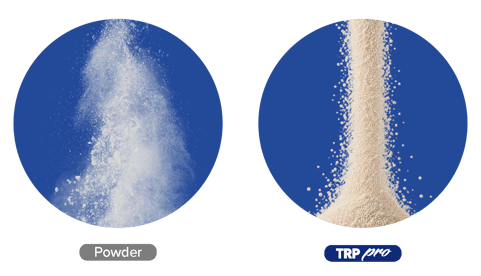
TRP Pro is CJ BIO's granulated L-tryptophan, designed to deliver benefits beyond conventional tryptophan.
Beyond supplying tryptophan, its unique composition offers additional nutritional value, while its granular form brings operational advantages to feed production, including less dust, more accurate dosing, and better mixing uniformity.
Compared with conventional 98% tryptophan, TRP Pro has a higher product inclusion rate to deliver an equivalent amount of L-tryptophan. In production systems equipped for automated weighing, this higher dosing volume can also facilitate automated handling, reducing the need for manual weighing in certain applications.
As CJ BIO introduced TRP Pro as its primary tryptophan solution in Brazil, the first step was to build customer confidence in its performance compared with conventional powdered tryptophan.
Before proceeding with formulation feasibility evaluations, CJ BIO shared in vivo trial results with Brazilian customers, demonstrating comparable or improved performance of TRP Pro versus conventional powdered tryptophan in piglets, broilers, and laying hens.
These findings helped establish a shared understanding of TRP Pro's performance potential, providing a foundation for the next step: evaluating its nutritional and economic feasibility in customers' existing feed formulations.

With confidence in TRP Pro's performance established, the next challenge was to determine how it could fit into customers' existing feed formulations.
Moving from conventional 98% tryptophan to a granulated solution required customers to assess how TRP Pro would perform within their existing nutritional and operational constraints.
CJ BIO supported customers with technical data and a straightforward evaluation process:
This approach enabled customers to assess the feasibility of transitioning from powder to granule using their own formulations, rather than relying solely on product specifications.
Approximately 90% of evaluated customers found TRP Pro technically and economically viable following formulation simulation.
The evaluations showed that TRP Pro could be incorporated while maintaining nutritional specifications and achieving favorable formulation economics.
For premix manufacturers, the higher product inclusion rate initially raised questions about available formulation space. However, simulations generally demonstrated that sufficient space was available while also identifying potential cost advantages.
By evaluating the complete nutritional matrix alongside inclusion rates and formulation economics, customers could make informed decisions about replacing conventional 98% tryptophan with TRP Pro.
With technical and economic feasibility confirmed through formulation simulation, customers were able to move forward with the transition from conventional 98% tryptophan powder to TRP Pro granule.
Supported by CJ BIO's technical expertise and formulation-based evaluation, TRP Pro achieved broad adoption across CJ BIO's Brazilian customer base, becoming its primary tryptophan solution in Brazil.
Successful product transitions start with helping customers overcome barriers to adoption.
The Brazilian case demonstrates CJ BIO's ability to address customer uncertainties through technical expertise and formulation support, turning a promising alternative into a practical, viable solution.
Discover TRP Pro's potential value with CJ BIO experts.
Assess feasibility in your own feed formulations.
Make a confident, evidence-based transition decision.
CJ Cheiljedang
CJ Cheiljedang center, 330, Dongho-ro, Jung gu, Seoul 04560, Korea
Ph: +82-10-4849-9625
Email: goeun.kim2@cj.net
Website: www.cjbio.net
is the data controller as defined in the EU General Data Protection Regulation (DSGVO) and the national data privacy laws.
We collect and use the personal data of users of our homepage only to the extent that this is necessary for keeping our website, contents and services functioning properly. Basically, we collect and use our users’ personal data only after they give their consent. An exception to this principle applies in cases where processing the data by statutory provisions is permitted or when obtaining prior consent for actual reasons is not possible.
The legal basis for processing personal data is basically based on:
The personal data of users will be deleted or blocked as soon as the purpose of the storage is no longer applicable. Additional storage may be provided for by European or national legislators through EU regulations, laws or other regulations to which the data controller is subject. Blocking or deleting the data also takes place when a storage period prescribed by the standards mentioned expires, unless there is a need for additional storage of the data for concluding a contract or fulfilling the contract.
Every time our website is accessed, our system automatically collects data and information from the user's computer system. The following information is collected:
Our system must temporarily store user IP addresses to allow us to deliver our website to the user's computer. To do this, the user's IP address must be stored for the duration of the session. Storage in log files is done to ensure the functionality of the website. In addition, the data is used to optimize the website and to ensure the security of our information technology systems. This data is not evaluated for marketing purposes in this context. The legal basis for the temporary storage of data and log files is Art. 6 Section 1 lit. f GDPR. Collecting your personal data to ensure our web presence and storing this data in log files is essential for operating our website. A contradictory possibility of the user therefore does not exist.
Your data will be deleted as soon as they are no longer necessary for achieving the purpose of the inquiry. Your data will be deleted when the session ends if your data has been collected to ensure the site's availability. If your data is stored in log files, it will be deleted after seven days at the latest. Further storage is possible, whereby in this case, the IP addresses of the users are deleted or alienated. This means that it is then no longer possible to assign the client who has accessed our website.
The described data are stored in the log files of our system. This data is not stored together with any other personal user data.
We use cookies on our website. Cookies are text files that are stored in the Internet browser or by the Internet browser on the user’s computer system. If you display a webside; this is how a cookie can be stored on your operating system. This cookie contains a characteristic string that allows the browser to be clearly when the website is accessed again. We use cookies to make our homepage more user friendly. Some elements of our website require that the browser be identified even after a page break. The following data is stored and transmitted:
The legal basis for processing personal data using cookies is defined in Article 6 Section 1 lit. f GDPR. The purpose for using technically required cookies is to simplify the use of our website. We would like to point out that some functions on our website can only be offered if cookies are enabled. This applies to the following applications:
We do not use user data collected by technically required cookies to create user profiles. Cookies are stored on the user’s computer, which transmits them to our page. As a user, you therefore have control over the use of cookies. You can restrict or disable transmission of cookies by making changes to your Internet browser settings. Here you can also delete cookies that have been stored. Please note that you may not be able to use all the features on our website if you deactivate cookies.
According to the EU General Data Protection Regulation, as an affected party you have the following rights:
You will find a contact form on our homepage that you can use to contact us electronically. The data entered into the input mask are transmitted to us and stored. These data include: The following data is also stored once the message has been sent:
It is also possible to contact us via our provided email address. In this case, the user's personal data transmitted by email will be stored. A transfer of your data to third parties will not take place in this context; this data will be used exclusively for processing the communication record. The legal basis for processing the data is in submitting user consent as defined in Art. 6 Section 1 lit. a GDPR. The legal basis for processing the data transmitted while sending an email is Article 6 Section 1 lit. f GDPR. If the email contact aims to conclude a contract, then additional legal basis for the processing is Art. 6 Section 1 lit. b GDPR. Processing personal data in this context is solely for processing the contact. In the case of contact via email, this also includes the required legitimate interest in processing the data. If further personal data are processed during the sending process, then they serve only to prevent misuse of the contact form and to ensure the security of our information technology systems. Your data will be deleted as soon as they are no longer necessary for achieving the purpose of the inquiry. Regarding the personal data from the input form on the contact form and those sent by email, this is the case when the respective conversation with the user has ended. The conversation is ended when it can be inferred from the circumstances that the relevant facts have been finally clarified. The additional personal data collected during the sending process will be deleted at the latest after a period of seven days. You will have the opportunity to revoke your consent to the processing of personal data at any time. Even when contacting us by email, you can object to the storage of your personal data at any time. However, we would like to point out that in such a case, the conversation cannot continue. All personal data stored while contacting will be deleted in this case.