






Muscle Loss: The Emerging Health Crisis and Consumer Response

2026.07.02

Muscle Loss: The Emerging Health Crisis and Consumer Response

Beyond Basic Protein: Why the Rapidly Aging Global Market Demands Mechanism-Driven Solutions for Sarcopenia. 

Skeletal muscle plays a central role in metabolic function, regulating glucose uptake, lipid metabolism, and overall energy balance[1]. As global populations continue to age and longevity becomes an increasingly shared priority, preserving muscle mass has emerged as a critical health imperative. After the age of 50, muscle mass declines at a rate of 1–2% per year, and an estimated 5–13% of adults between the ages of 60 and 70 are affected by sarcopenia[2]. This age-related muscle loss compromises mobility, quality of life, and functional independence[3], while also contributing to reduced metabolic resilience with aging. Given these challenges, the elderly nutrition market focused on mitigating muscle loss is expanding rapidly, with consumers increasingly turning to natural and novel ingredients as preferred solutions.


📌Quick Overview: Why Ursolic Acid for Muscle Health?

Key Challenge

The Solution: Ursolic Acid (UA)

Benefits of Leanepic™ (50% UA)

• Sarcopenia (1-2% loss/year)


• Limits of traditional protein/creatine

• Pentacyclic triterpenoid from rosemary


• Dual action: Anabolic & Anti-catabolic

• Strictly standardized to 50% UA


• FDA NDI notified & Globally patented


Science of Ursolic Acid :Moving Beyond Traditional Protein 

Conventional ingredients for muscle health, such as protein and creatine, are limited in their ability to modulate the intracellular signaling pathways for muscle adaptation[4]. This creates a critical need for mechanism-driven solutions. So, consumers are seeking natural, safe, and effective alternatives to synthetic anabolic agents. 

Ursolic acid (UA) is a naturally occurring pentacyclic triterpenoid widely distributed across a diverse range of plant sources. It is found abundantly in the peels of apples, as well as in rosemary, basil, thyme, sage, blueberries, cranberries, and guava, among others[5]. Long recognized in traditional herbal medicine for its anti-inflammatory and antioxidant properties, ursolic acid has in recent years attracted substantial scientific interest for its multi-target bioactivity; spanning anti-diabetic, anti-obesity, hepatoprotective, and notably, muscle anabolic effects. Collectively, this body of evidence positions ursolic acid as one of the promising bioactive compounds in the field of muscle and metabolic health. 


Preclinical Evidence Supporting Ursolic acid

The functionality and mechanism of ursolic acid, have been extensively investigated through systematically designed experiments. Recognized for its novelty and efficacy, ursolic acid has even secured a global patent. Here, we introduce the journey of discovering this remarkable compound.

Research has shown that ursolic acid influences several of the body’s most important anabolic signaling pathways. In a landmark study, the research team employed a multi-step, precise experimental design to find a natural compound that inhibits muscle atrophy and increases muscle mass. The key experimental process is divided into three main stages: mRNA identification, candidate discovery via the Connectivity Map, and efficacy validation using animal models[6].

[1]  Wolfe RR., Am J Clin Nutr., 2006  [2] von Haehling et al., Journal of cachexia, sarcopenia and muscle, 2010 [3] Cruz-Jentoft AJ et al., Age Ageing., 2010 [4] Phillips SM., Sports Med., 2014 [5] Rathor, R et al. Free Radical Biology and Medicine, 2021 [6] Kunkel SD et al., Cell Metabolism., 2011 
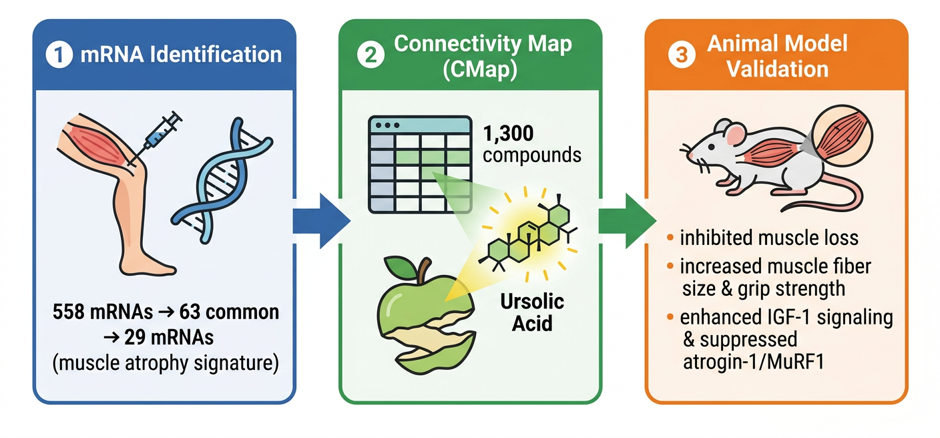
 

  • Figure 1. 3-Stage Research Process of Ursolic acid

① Identification of Muscle Atrophy-Related mRNA

Seven healthy adults were subjected to a 40-hour fast, after which RNA was extracted and analyzed via thigh muscle biopsies. This process identified 558 mRNAs that showed altered expression levels before and after fasting.

By identifying 63 mRNAs that commonly change during fasting in both humans and mice, the team established a biologically conserved "muscle atrophy signature."

Additionally, by combining data from patients suffering from muscle atrophy due to spinal cord injury (SCI) with the fasting data, they created another signature comprising 29 common mRNAs.

② Substance Exploration via the Connectivity Map (CMap)

The CMap database was utilized to identify drugs capable of reversing the discovered "muscle atrophy gene patterns." The muscle atrophy mRNA signatures were cross-referenced with CMap, which records the effects of over 1,300 small-molecule compounds on cellular genes. The results revealed that ursolic acid, a compound abundant in apple peels, was the only common candidate selected in two independent queries for exerting the exact opposite effect on the gene changes that cause muscle atrophy.

③ Efficacy and Mechanism Validation Using Animal Models

Various mouse experiments were conducted to confirm the actual effects of the selected ursolic acid.

1) Muscle loss was significantly inhibited in mice with induced muscle atrophy (via fasting or nerve denervation) following the administration of ursolic acid.

2) When normal mice without any muscle atrophy factors were fed a diet containing ursolic acid for 5 weeks, their muscle fiber size increased, and their grip strength was significantly enhanced.

3) It was revealed that ursolic acid enhances insulin/IGF-1 signaling in the muscles of mice and suppresses the expression of atrogin-1 and MuRF1, which are key genes involved in muscle breakdown.

Through this step-by-step and systematic experimental design, the research team demonstrated that ursolic acid is an effective natural compound with the potential to mitigate muscle atrophy and increase muscle mass.

Body Recomposition and Metabolic Benefits of Ursolic acid

One of the most intriguing findings of ursolic acid research is its apparent ability to support body recomposition by promoting muscle growth while reducing fat accumulation simultaneously. After confirming in previous studies, the research team aimed to verify whether it could suppress obesity, glucose intolerance, and fatty liver through the activation of Akt in muscles using a high-fat diet-induced obesity model[7].
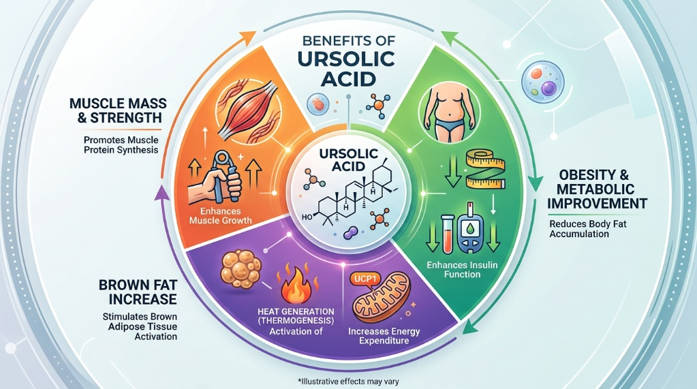
Figure 2. Metabolic benefits of Ursolic acid

① Increase in Muscle Mass and Strength

Muscle mass significantly increased in mice that consumed a high-fat diet simultaneously with ursolic acid. Both fast and slow muscle fibers increased in size, and actual grip strength and treadmill endurance were enhanced. As revealed in previous studies, this is because ursolic acid aids in the phosphorylation of the Akt protein in muscles, promotes IGF-1 signaling, and suppresses muscle atrophy genes.

② Obesity Suppression and Metabolic Improvement

The group administered with ursolic acid showed less weight gain and a decrease in body fat mass compared to the control group. Furthermore, insulin resistance decreased, glucose tolerance improved, and triglyceride accumulation in the liver was significantly reduced, demonstrating a preventive effect against non-alcoholic fatty liver disease (NAFLD).

③ Increase in Brown Fat

One of the most interesting findings in this study is that ursolic acid increased the amount of brown adipose tissue (BAT). Unlike white fat, which stores energy, brown fat burns energy to generate heat. Ursolic acid increased energy expenditure by upregulating the expression of UCP1 (a thermogenic protein) within brown fat

The experiment proved that ursolic acid goes beyond merely building muscle; it elevates overall energy metabolism by simultaneously increasing both muscle and brown fat mass. As a result, ursolic acid demonstrated effect against the development of obesity, insulin resistance, and fatty liver, even when subjected to a high-fat diet.

Leanepic™: A Differentiated Nutritional Ingredient Platform 

The future of muscle health supplementation is moving beyond basic nutrition towards targeted biological optimization. Leanepic™, a natural plant-based ingredient extracted from rosemary leaves, is a differentiated nutritional ingredient platform that perfectly aligns with these global consumer demands.

FAQ: What makes Leanepic™ a premium ingredient for global B2B formulations?

Answer: Leanepic™ is strictly standardized to a high concentration of 50% Ursolic Acid, ensuring consistent biological activity. It is backed by robust preclinical evidence, holds an FDA NDI notification, and is manufactured under exclusive global patents.

Key Applications & Market Solutions:

• Sports Nutrition: Supporting high-intensity performance and muscle recovery.
• Healthy Aging:
Mitigating sarcopenia and preserving muscle mass in the elderly.
• Weight Management:
Promoting body recomposition (muscle gain and fat loss).
• Functional Foods & Beverages:
Easily integrated into everyday consumer delivery formats.

CJ BIO of CJ CheilJedang is the worldwide exclusive supplier of Leanepic™ based on proprietary patents[9]. The company is currently embarking on a clinical validation program to test the scientific efficacy of this unique form of ursolic acid in healthy human volunteers, paving the way for widespread use in dietary supplements and functional foods.

Please contact your local sales representative for more details.


References

1. Wolfe, R. R. (2006). The underappreciated role of muscle in health and disease. The American journal of clinical nutrition, 84(3), 475-482.
2. von Haehling, S., Morley, J. E., & Anker, S. D. (2010). An overview of sarcopenia: facts and numbers on prevalence and clinical impact. Journal of cachexia, sarcopenia and muscle, 1(2), 129-133.
3. Cruz-Jentoft, A. J., Baeyens, J. P., Bauer, J. M., Boirie, Y., Cederholm, T., Landi, F., ... & Zamboni, M. (2010). Sarcopenia: European consensus on definition and diagnosis: Report of the European Working Group on Sarcopenia in Older People. Age and ageing, 39(4), 412-423.
4. Phillips, S. M. (2014). A brief review of critical processes in exercise-induced muscular hypertrophy. Sports Medicine, 44(Suppl 1), 71-77.
5. Rathor, R., Suryakumar, G., & Singh, S. N. (2021). Diet and redox state in maintaining skeletal muscle health and performance at high altitude. Free Radical Biology and Medicine, 174, 305-320.
6. Kunkel, S. D., Suneja, M., Ebert, S. M., Bongers, K. S., Fox, D. K., Malmberg, S. E., ... & Adams, C. M. (2011). mRNA expression signatures of human skeletal muscle atrophy identify a natural compound that increases muscle mass. Cell metabolism, 13(6), 627-638.
7. Kunkel, S. D., Elmore, C. J., Bongers, K. S., Ebert, S. M., Fox, D. K., Dyle, M. C., ... & Adams, C. M. (2012). Ursolic acid increases skeletal muscle and brown fat and decreases diet-induced obesity, glucose intolerance and fatty liver disease. PloS one, 7(6), e39332.
8. CJ Cheiljedang. (2025). Leanepic Rosemary Concentrate Containing 50 Ursolic Acid. FDA-2025-S-0023-0060. U.S. Food and Drug Administration.
https://www.regulations.gov/document/FDA-2025-S-0023-0060
9. Adams, C. M., Kunkel, S. D., & Welsh, M. (2020). Methods for inhibiting muscle atrophy (U.S. Patent No.10668087B2). U.S. Patent and Trademark Office. 
https://www.regulations.gov/document/FDA-2025-S-0023-0060


This statement has not been evaluated by the Food and Drug Administration. This product is not intended to diagnose, treat, cure, or prevent any disease.


References

1. Wolfe, R. R. (2006). The underappreciated role of muscle in health and disease. The American journal of clinical nutrition, 84(3), 475-482.
2. von Haehling, S., Morley, J. E., & Anker, S. D. (2010). An overview of sarcopenia: facts and numbers on prevalence and clinical impact. Journal of cachexia, sarcopenia and muscle, 1(2), 129-133.
3. Cruz-Jentoft, A. J., Baeyens, J. P., Bauer, J. M., Boirie, Y., Cederholm, T., Landi, F., ... & Zamboni, M. (2010). Sarcopenia: European consensus on definition and diagnosis: Report of the European Working Group on Sarcopenia in Older People. Age and ageing, 39(4), 412-423.
4. Phillips, S. M. (2014). A brief review of critical processes in exercise-induced muscular hypertrophy. Sports Medicine, 44(Suppl 1), 71-77.
5. Rathor, R., Suryakumar, G., & Singh, S. N. (2021). Diet and redox state in maintaining skeletal muscle health and performance at high altitude. Free Radical Biology and Medicine, 174, 305-320.
6. Kunkel, S. D., Suneja, M., Ebert, S. M., Bongers, K. S., Fox, D. K., Malmberg, S. E., ... & Adams, C. M. (2011). mRNA expression signatures of human skeletal muscle atrophy identify a natural compound that increases muscle mass. Cell metabolism, 13(6), 627-638.
7. Kunkel, S. D., Elmore, C. J., Bongers, K. S., Ebert, S. M., Fox, D. K., Dyle, M. C., ... & Adams, C. M. (2012). Ursolic acid increases skeletal muscle and brown fat and decreases diet-induced obesity, glucose intolerance and fatty liver disease. PloS one, 7(6), e39332.
8. CJ Cheiljedang. (2025). Leanepic Rosemary Concentrate Containing 50 Ursolic Acid. FDA-2025-S-0023-0060. U.S. Food and Drug Administration.
https://www.regulations.gov/document/FDA-2025-S-0023-0060
9. Adams, C. M., Kunkel, S. D., & Welsh, M. (2020). Methods for inhibiting muscle atrophy (U.S. Patent No.10668087B2). U.S. Patent and Trademark Office. 
https://www.regulations.gov/document/FDA-2025-S-0023-0060


A. Privacy policy according to the GDPR

I. Name and address of the data controller

CJ Cheiljedang
CJ Cheiljedang center, 330, Dongho-ro, Jung gu, Seoul 04560, Korea
Ph: +82-10-4849-9625
Email: goeun.kim2@cj.net
Website: www.cjbio.net
is the data controller as defined in the EU General Data Protection Regulation (DSGVO) and the national data privacy laws.

II. information about data processing

  • 1. The extent to which personal data is processed

    We collect and use the personal data of users of our homepage only to the extent that this is necessary for keeping our website, contents and services functioning properly. Basically, we collect and use our users’ personal data only after they give their consent. An exception to this principle applies in cases where processing the data by statutory provisions is permitted or when obtaining prior consent for actual reasons is not possible.

  • 2. Legal basis for processing personal data

    The legal basis for processing personal data is basically based on:

    • • Art. 6 Section 1 lit. a GDPR upon obtaining the consent of the data subject.
    • • Art. 6 Section 1 lit. b GDPR for processing operations that serve to fulfill a contract to which the data subject is a party. Included here are processing operations that are necessary to carry out pre-contractual measures.
    • • Art. 6 Section 1 lit. c GDPR for processing required to fulfill a legal obligation.
    • • Art. 6 Section 1 lit. d GDPR, if vital interests of the data subject or another natural person require the processing of personal data.
    • • Art. 6 Section 1 lit. f GDPR, if the processing is necessary to safeguard the legitimate interests of our company or a third party, and the interests, fundamental rights and fundamental freedoms of the data subject do not outweigh the former interest.
  • 3. Data erasure and storage duration

    The personal data of users will be deleted or blocked as soon as the purpose of the storage is no longer applicable. Additional storage may be provided for by European or national legislators through EU regulations, laws or other regulations to which the data controller is subject. Blocking or deleting the data also takes place when a storage period prescribed by the standards mentioned expires, unless there is a need for additional storage of the data for concluding a contract or fulfilling the contract.

III. Use of our website, general information

  • 1. Description and scope of data processing

    Every time our website is accessed, our system automatically collects data and information from the user's computer system. The following information is collected:

    • (1) The user’s IP address
    • (2) Date and time of access
  • 2. Purpose and legal basis for data processing

    Our system must temporarily store user IP addresses to allow us to deliver our website to the user's computer. To do this, the user's IP address must be stored for the duration of the session. Storage in log files is done to ensure the functionality of the website. In addition, the data is used to optimize the website and to ensure the security of our information technology systems. This data is not evaluated for marketing purposes in this context. The legal basis for the temporary storage of data and log files is Art. 6 Section 1 lit. f GDPR. Collecting your personal data to ensure our web presence and storing this data in log files is essential for operating our website. A contradictory possibility of the user therefore does not exist.

  • 3. Duration of storage

    Your data will be deleted as soon as they are no longer necessary for achieving the purpose of the inquiry. Your data will be deleted when the session ends if your data has been collected to ensure the site's availability. If your data is stored in log files, it will be deleted after seven days at the latest. Further storage is possible, whereby in this case, the IP addresses of the users are deleted or alienated. This means that it is then no longer possible to assign the client who has accessed our website.

The described data are stored in the log files of our system. This data is not stored together with any other personal user data.

IV. General information about the use of cookies

We use cookies on our website. Cookies are text files that are stored in the Internet browser or by the Internet browser on the user’s computer system. If you display a webside; this is how a cookie can be stored on your operating system. This cookie contains a characteristic string that allows the browser to be clearly when the website is accessed again. We use cookies to make our homepage more user friendly. Some elements of our website require that the browser be identified even after a page break. The following data is stored and transmitted:

  • (1) Language settings

The legal basis for processing personal data using cookies is defined in Article 6 Section 1 lit. f GDPR. The purpose for using technically required cookies is to simplify the use of our website. We would like to point out that some functions on our website can only be offered if cookies are enabled. This applies to the following applications:

  • (1) Adopting language settings
  • (2) Remembering keywords

We do not use user data collected by technically required cookies to create user profiles. Cookies are stored on the user’s computer, which transmits them to our page. As a user, you therefore have control over the use of cookies. You can restrict or disable transmission of cookies by making changes to your Internet browser settings. Here you can also delete cookies that have been stored. Please note that you may not be able to use all the features on our website if you deactivate cookies.

V. Your rights/rights of the data subject

According to the EU General Data Protection Regulation, as an affected party you have the following rights:

  • 1. The right to receive information
    As the data controller, you have the right to receive information from us regarding processing personal data involving you. In addition, you may request information about the following:
    • (1) The purpose of the data processing
    • (2) The categories of personal data that are processed
    • (3) The recipients or categories of recipients to whom the personal data relating to you have been disclosed or are still being disclosed
    • (4) The planned duration of the storage of your personal data or, if specific information is not available, the criteria for determining the duration of storage
    • (5) The existence of a right to rectification or erasure of personal data concerning you, a right to restriction of processing by the data controller or concerned, or a right to object to such processing
    • (6) The existence of a right of appeal to a supervisory authority
    • (7) All available information on the source of the data if the personal data are not collected from the data subject
    • (8) The existence of automated decision-making, including profiling according to Art. 22 Section 1 and 4 GDPR and - at least in these cases - meaningful information about the logic involved as well as the scope and the intended effects of such processing on the data subject.
    Finally, you also have the right to request information about whether your personal information is being transferred to a third country or to an international organization. In this case, you can obtain information about the appropriate guarantees in accordance with Art. 46 GDPR regarding such transfer. You can claim your right to information under: Email: goeun.kim2@cj.net
  • 2. The right to rectification
    If we process your personal data incorrectly or in an incomplete manner, then you have a right for it to be corrected/completed. The correction will be made immediately.
  • 3. Right to restriction
    The right to limit the processing of your personal data may be asserted in the following cases:
    • (1) The accuracy of the personal data is contested for a period of time, enabling the data controller to verify the accuracy of the personal data.
    • (2) The processing is unlawful and deleting the personal data is rejected, whereby the restriction of the use of personal data is required.
    • (3) The data controller no longer needs the personal data for purposes of processing, but the data subject needs them to assert, exercise or defend legal claims, or
    • (4) The data subject filed an objection to the processing pursuant to Art. 21 Section 1 GDPR and it is not yet clear whether the legitimate reasons of the data controller outweighed those of the data subject.
    If processing personal data concerning you has been restricted, such data—viewed separately from your data storage—may be stored only with your consent or for the purposes of asserting, exercising or defending legal claims or protecting the rights of another natural or legal person or important public interest of the Union or of a Member State. If there is a processing restriction in accordance with the principles outlined, you will be informed by us before the restriction is lifted.
  • 4. The right to delete
    You can request that your personal data be deleted immediately if you can show the following reasons: The data controller is obligated to delete this data immediately. These reasons include:
    • (1) Your personal data are no longer necessary for the purposes for which they were collected or otherwise processed.
    • (2) The processing is based on a consent according to Art. 6 Section 1 lit. a or Art. 9 Section 2 lit. a GDPR protected and you revoke the consent. Another condition is that there is no other legal basis for the processing.
    • (3) You object to the processing (Art. 21 Section 1 GDPR) and there are no legitimate reasons for the processing. Another possibility is that you have a protest against the processing pursuant to Art. 21 Section 2 GDPR.
    • (4) The processing of your personal data is unlawful.
    • (5) Deleting personal data concerning you is required to fulfill a legal obligation under Union law or the law of the Member States to which the data controller is subject.
    • (6) The personal data concerning you were collected in relation to information society services offered pursuant to Art. 8 Section 1 GDPR.
    If we have made personal data concerning you public and we are obligated to delete them according to Art. 17 Section 1 of the GDPR, then we shall take appropriate measures, while also taking the available technology, implementation costs and the available technology into account, to inform data controllers who process the personal data that you, as the data subject, have requested the deletion of all links to such personal data or of copies or replications of such personal data. We would like to point out that the right to delete does not exist to the extent that processing is required:
    • (1) to exercise the right to freedom of expression and information
    • (2) to fulfill a legal obligation required by the law of the Union or of the Member States to which the controller is subject, or to carry out a task of public interest or to exercise the official authority conferred on the controller
    • (3) for reasons of public interest in the field of public health pursuant to Art. 9 Section 2 lit. h and i and Art. 9 (3) GDPR
    • (4) for archival purposes of public interest, scientific or historical research purposes or for statistical purposes pursuant to Art. 89 Section 1 GDPR, to the extent that the law referred to in Section (a) is likely to render impossible or seriously affect the achievement of the objectives of that processing, or
    • (5) to assert, exercise or defend legal claims.
  • 5. Right to information
    If you have asserted the right to rectify, delete or restrict the processing, we are obligated to notify all recipients to whom your personal data have been disclosed of this correction or deletion of the data or restriction of processing, unless this proves to be impossible or is associated with a disproportionate amount of effort. You also have the right to be informed about these recipients.
  • 6. Right to data portability
    According to the GDPR, you also have the right to obtain the personal data provided to us and to receive it in a structured, understandable and machine-readable format. Furthermore, you have the right to transfer this data to another data controller without hindrance by the data controller for providing the personal data, provided that
    • • the processing is based on consent as defined in Art. 6 Section 1 lit. a GDPR or Art. 9 Section 2 lit. a GDPR or on a contract acc. Art. 6 Section 1 lit. b GDPR
    • • and the processing is done using automated procedures.
    Finally, where technically feasible and without harm to the freedoms and rights of others and as part of exercising the right of data transferability, you have the right to obtain that personal data related to you that has been transmitted directly from one controller to another. The right to data portability does not apply to processing that personal data necessary for performing a task in the public interest or for exercising the official authority that has been delegated to the data controller.
  • 7. Right to revoke the declaration of consent to data protection
    You have the right to revoke your data protection declaration at any time. Please note that revoking consent does not affect the lawfulness of the processing carried out based on the consent until the revocation goes into effect.
  • 8. Right to objection
    Furthermore, for reasons based on your particular situation, you have the right at any time to file an objection to the processing of personal data relating to you, as it is defined in Art. 6 Section 1 lit. e or f GDPR. The right of objection also applies to profiling based on these provisions. The data controller will no longer process the personal data concerning you unless he can demonstrate compelling legitimate grounds for processing that outweigh your interests, rights and liberties, or the processing is for enforcing, exercising or defending legal claims. If the personal data related to you are processed for advertising purposes, then you have the right to object at any time to your personal data being processed for such advertising. This also applies to profiling, as far as it is associated with such direct marketing. Your personal data will no longer be processed for direct marketing purposes if you object to your data being used for such purposes. You also have the option of discussing the use of information society services (despite Directive 2002/58/EC). Exercise your right to object by using automated procedures that use technical specifications.
  • 9. Automated decision on an individual basis, including profiling
    Under the EU General Data Protection Regulation, you remain entitled not to be subjected to a decision based solely on automated processing - including profiling - which would have legal effect or would affect you in a similar manner. An exception to this principle, however, is when the decision
    • (1) is required for concluding or fulfilling a contract between you and the data controller,
    • (2) and is permissible based on Union or Member State legislation to which the controller is subject, and that legislation contains adequate measures to safeguard your rights and freedoms and your legitimate interests, or
    • (3) is with your express consent.
    If the processing is carried out in accordance with the cases mentioned in Section 1 and 3, then the data controller shall take appropriate measures to safeguard your rights and freedoms as well as your legitimate interests. This includes at least the right to obtain the intervention of a person on the part of the data controller to state his own position and to contest the decision. The ruling under (1) – (3) may not be based on special categories of personal data pursuant to Art. 9 Section 1 GDPR, unless Art. 9 Section 2 lit. a or g and reasonable measures have been taken to protect the rights and freedoms and your legitimate interests.
  • 10. Right to complain to a supervisory authority
    Finally, if you believe that the processing of personal data concerning you is contrary to the GDPR, you have the right to complain to a supervisory authority, in the Member State of its place of residence, employment or the location of the alleged infringement.

VII. Newsletter

  • 1. General
    You can subscribe to a free newsletter on our homepage that we use to inform you about our current interesting offers. The advertised goods and services are named in the declaration of consent. The data you enter in the online registration form will be transmitted to us. We collect the following data based on the consent obtained during the registration process: e-mail address, the date and the hour of the registration. Your data will not be forwarded as part of data processing involved in sending newsletters. The data will be used exclusively for sending the newsletter.
  • 2. Double opt-in and logging
    Registration for our newsletter takes place in a so-called double-opt-in procedure. After registration, you will receive an email asking you to confirm your registration. This confirmation is necessary so that nobody can register using external email addresses. The registration for the newsletter will be logged to prove the registration process according to the legal requirements. This includes the storage of the login and the confirmation time, as well as the IP address.
  • 3. Legal basis
    Legal basis for processing the data is once the consent of the user Art. 6 Section 1 lit. a GDPR has been submitted. Collecting the user's email address aids in delivering the newsletter.
  • 4. Cancellation, revocation and opposition
    Your data will be deleted as soon as they are no longer necessary for achieving the purpose of the inquiry. Your email address will therefore be saved as long as the subscription to the newsletter is active. You may terminate subscription to the newsletter at any time by revoking your consent. There is a corresponding link in each newsletter to do this. We would like to further point out that at any time, you are free to cancel any future processing of your personal data in accordance with the statutory requirements. pursuant to Art. 21 GDPR. You are free to object to your data being processed for direct marketing purposes.

VIII. Electronic contact

You will find a contact form on our homepage that you can use to contact us electronically. The data entered into the input mask are transmitted to us and stored. These data include: The following data is also stored once the message has been sent:

  • (1) Date and time of registration

It is also possible to contact us via our provided email address. In this case, the user's personal data transmitted by email will be stored. A transfer of your data to third parties will not take place in this context; this data will be used exclusively for processing the communication record. The legal basis for processing the data is in submitting user consent as defined in Art. 6 Section 1 lit. a GDPR. The legal basis for processing the data transmitted while sending an email is Article 6 Section 1 lit. f GDPR. If the email contact aims to conclude a contract, then additional legal basis for the processing is Art. 6 Section 1 lit. b GDPR. Processing personal data in this context is solely for processing the contact. In the case of contact via email, this also includes the required legitimate interest in processing the data. If further personal data are processed during the sending process, then they serve only to prevent misuse of the contact form and to ensure the security of our information technology systems. Your data will be deleted as soon as they are no longer necessary for achieving the purpose of the inquiry. Regarding the personal data from the input form on the contact form and those sent by email, this is the case when the respective conversation with the user has ended. The conversation is ended when it can be inferred from the circumstances that the relevant facts have been finally clarified. The additional personal data collected during the sending process will be deleted at the latest after a period of seven days. You will have the opportunity to revoke your consent to the processing of personal data at any time. Even when contacting us by email, you can object to the storage of your personal data at any time. However, we would like to point out that in such a case, the conversation cannot continue. All personal data stored while contacting will be deleted in this case.

IX. Web analytics

  • 1. Use of Google Analytics
    This website uses Google Analytics, a web analytics service provided by Google Inc. (“Google”). Google Analytics uses so-called "cookies," text files that are stored on your computer and they allow how you use the website to be analyzed. The information generated by the cookie about your use of this website is usually transmitted to a Google server in the US and is stored there. However, if IP anonymization is activated on this website, your IP address will be shortened by Google beforehand within member states of the European Union or in other contracting states of the Agreement on the European Economic Area. Only in exceptional cases will the full IP address be sent to a Google server in the US and shortened there. On behalf of the operator of this website, Google will use this information to evaluate your use of the website, to compile reports on website activity and to provide other services related to website and Internet usage to the website operator. The IP address provided by Google Analytics within the framework of Google Analytics will not be merged with other data provided by Google. You can prevent the storage of cookies by enabling a corresponding setting in your browser software; however, please note that if you do this, you may not be able to use all the features of this website to the fullest extent possible. You may also prevent Google from collecting the data generated by the cookie and related to your use of the website (including your IP address) as well as prevent Google from processing this data by downloading and installing the browser plug-in available under the following link: http://tools.google.com/dlpage/gaoptout?hl=de. This website uses Google Analytics with the extension "_anonymizeIp()." As a result, IP addresses are processed shortened so that they cannot be related to any one particular person. Insofar as the data collected about you is assigned a personal reference, it will be immediately excluded, and the personal data will be deleted immediately. We use Google Analytics to analyze and regularly improve the use of our website. We use the statistics to improve our offer and make it more interesting for you as a user. Google has submitted to the EU-US Privacy Shield, Framework for those exceptional cases in which personal information is transferred to the US. The legal basis for using Google Analytics Art. 6 Section 1 p. 1 lit. a GDPR. Third-party information: Google Dublin, Google Ireland Ltd., Gordon House, Barrow Street, Dublin 4, Ireland, Fax: +353 (1) 436 1001. User conditions: http://www.google.com/analytics/terms/de.html, Data privacy overview: http://www.google.com/intl/de/analytics/learn/privacy.html, data protection policy: http://www.google.de/intl/de/policies/privacy. This site also uses Google Analytics for cross-device analysis of visitor traffic and is conducted through the user ID. You can deactivate your cross-device analysis of your usage under "My Data,” then "Personal Data.”

X. Social Media

  • 1. Social media presence
    We maintain fan pages within various social networks and platforms for communicating with customers, prospects and users who are active there and for informing them about our services. We would like to point out that your personal data may be processed outside the European Union, which may pose risks to you (e.g. in enforcing your rights under European/German law). Please note that some US providers are certified under the Privacy Shield and are committed to respecting EU privacy standards. These users’ data are usually processed for market research and advertising purposes. Thus, for example, user profiles are created based on the user’s behavior and interests. These usage profiles can in turn be used to do such things as place advertisements inside and outside the platforms that are allegedly in line with users' interests. For these purposes, cookies are usually stored on the user’s computer where the user’s behavior and the user’s interests are stored. Furthermore, in the usage profiles, data can also be stored independently of the devices that the users use (this is especially true if the users are members of the respective platforms and are logged in to them). Processing personal user data is based on our legitimate interests in an effective user information and communication with users in accordance with. Art. 6 Section 1 lit. f. GDPR. The legal basis for processing user info is Art. 6 Section a., Art. 7 GDPR, and this entails the respective providers asking users to consent to data processing (that is, that they declare their agreement, for example, by ticking a check box or clicking on a button to confirm). Additional information about processing your personal data as well as your revocation options can be found under the links for the respective providers listed below. The assertion of information and further rights of the data subjects can likewise take place opposite the offerers, who then have only the direct access to the data of the users and have appropriate information. Of course, we are available for questions and support if you need help. Providers:

X. Social Media